Unschooling Vs Homeschooling — What’s The Difference?
Did you know that over 3.1 million children in the United States learn outside of traditional school settings? According to the National Home Education Research Institute, both homeschooling and unschooling are on the rise, especially as families seek more flexibility and control over their children’s education. But while these two terms are often used together, they are not the same. If you’re considering an alternative education path, understanding the real differences between unschooling and homeschooling is essential.
Defining Homeschooling And Unschooling
Homeschooling is an umbrella term. It covers any education that happens at home, directed by parents instead of a school. There are many ways to homeschool: some parents use structured curriculums, others mix and match subjects or follow their child’s interests, but all have one thing in common—learning happens outside of traditional school.
Some homeschooling families follow state-approved curriculums that look very similar to public school. They might use textbooks, online platforms, or even hire tutors for specialized subjects. Other families experiment with project-based learning or include more art, music, and physical activities than a regular classroom might allow.
Unschooling, on the other hand, is a specific approach within homeschooling. It removes formal lessons, fixed schedules, and standard curriculums. Instead, unschooling lets children learn naturally, following their curiosity and passions in daily life.
This might mean that a child spends weeks fascinated by space, building models of planets, watching documentaries, visiting science museums, and reading about astronauts. No two days look the same, and there’s no pressure to “finish” a unit before moving on.
Think of homeschooling as a broad road, with unschooling as a unique, winding path off that road.
Core Principles: Structure Vs. Freedom
The main difference between homeschooling and unschooling is structure.
- Homeschooling: Usually involves a schedule, set lessons, and sometimes tests. Parents often act as teachers.
- Unschooling: There’s no set curriculum or fixed timetable. Learning flows from the child’s interests. Parents act as guides and facilitators, not lecturers.
For example, a homeschooler might study math at 9 a. m. daily, using textbooks or workbooks. An unschooler might bake a cake, learning about measurements, fractions, and chemistry naturally during the process.
It’s important to note that even within homeschooling, there is a wide range. Some families are very strict about their daily routines, while others are more relaxed. Unschooling takes this flexibility even further, trusting that children will find and follow their own learning paths.
Another important distinction is that unschooling places a strong value on intrinsic motivation—the idea that kids learn best when they are internally motivated, not just following adult-set goals.

Credit: www.thehomeschoolmom.com
How Learning Happens
Let’s compare how each method works in real life.
Homeschooling
- Parents choose the curriculum, usually based on grade level.
- Subjects are taught in blocks (math, science, language arts).
- Children may have assignments, worksheets, and exams.
- Progress is tracked with grades or portfolios.
Some homeschoolers use online platforms where lessons and tests are provided, while others prefer hands-on projects, educational field trips, or local classes. Parents often set learning goals at the start of the year and check progress regularly. If a child struggles with a subject, the parent can slow down or try a different approach.
Unschooling
- The child’s interests lead the way.
- Subjects mix together (learning science while gardening, or history through family stories).
- No formal testing—learning is observed in real activities.
- Progress is personal and unique to each child.
A typical unschooling day might involve going to the library, exploring a local park, building something new, or having long conversations about a favorite topic. Parents pay close attention to what excites their child and help find resources, people, or experiences that deepen that interest.
One non-obvious insight: Unschoolers often develop strong research skills early, because they learn to seek out information independently—using books, the internet, and community experts.
Pros And Cons: Side-by-side Comparison
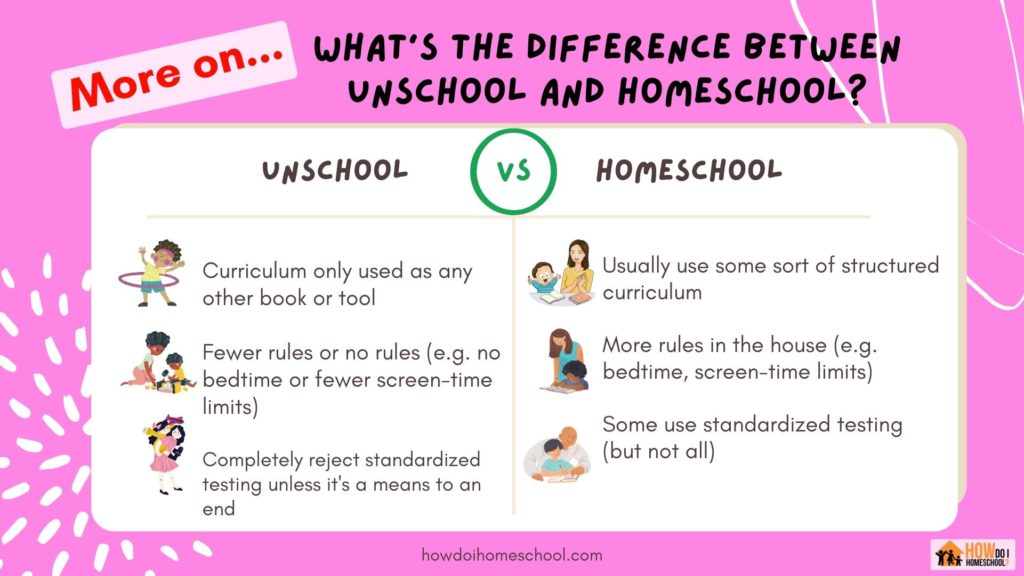
To make things clear, here’s a direct comparison:
| Aspect | Homeschooling | Unschooling |
|---|---|---|
| Structure | High (planned lessons, curriculum) | Low (child-led, spontaneous) |
| Flexibility | Medium (can adjust schedule) | Very high (no fixed schedule) |
| Parental Role | Instructor, organizer | Facilitator, supporter |
| Testing & Grades | Common | Rare or none |
| Learning Style | Varied, often traditional | Experiential, hands-on |
| Socialization | Planned with groups, co-ops | Informal, community-based |
| Accountability | Tracked (portfolios, reports) | Personal (observation, discussion) |
A less obvious difference is how each method handles “gaps” in learning. Homeschoolers may worry about covering every subject fully, while unschoolers trust that children will learn what they need, when they need it, often filling knowledge gaps as real-world situations arise.
Credit: howdoihomeschool.com
Real-world Examples
Homeschooling In Action
Maria, a homeschool parent in Texas, uses a mix of online and printed materials. Each day starts with reading, followed by math worksheets and science experiments. Her children join a local co-op for group classes twice a week. She tracks their progress with tests and keeps a portfolio for state requirements.
Maria adapts her lessons if her kids seem bored or confused. For example, if the math workbook is too easy, she introduces more challenging puzzles. She also plans field trips to museums and historical sites to make learning more engaging.
Homeschooling allows her to focus on her children’s strengths and give extra help when needed.
Unschooling In Action
The Patel family in California follows unschooling. Their daughter loves animals, so they visit farms, watch wildlife documentaries, and volunteer at a shelter. She reads about habitats and writes stories about animals. There’s no set schedule—her interests shape each day.
Sometimes her interests shift quickly—one week she’s fascinated by insects, the next she’s building a birdhouse with her dad. Her parents support her by finding books, arranging visits with local experts, or simply making space for her projects at home.
Over time, she develops deep knowledge in areas that excite her, and her parents notice she’s eager to share what she learns with others.
Why Families Choose Each Approach
Homeschooling: Why It Works
- Clear structure gives parents confidence.
- Easier to meet state requirements (attendance, grades).
- Feels familiar—similar to school but at home.
- Helpful for children who like routine or need special support.
Many families also choose homeschooling because they want to teach from a religious or cultural perspective, or because their child has special needs that are not well supported in traditional schools. Homeschooling can offer a safe environment for children who have experienced bullying or anxiety in regular classrooms.
Unschooling: Why It Works
- Freedom to explore individual passions.
- Builds self-motivation and independence.
- Flexible for travel, family needs, or unique learning styles.
- Reduces stress around tests and deadlines.
Unschooling is especially appealing to families who believe that learning happens everywhere, not just with books or in classrooms. Some families have children who don’t fit well in standard systems—they might be gifted, have learning differences, or simply want more time for creative or outdoor activities.
Credit: www.unschoolingmom2mom.com
Cost, Time, And Commitment
Many Parents Wonder: Which Option Is More Affordable And Time-friendly?
Homeschooling
- Costs: Curriculum, books, online programs, field trips.
- Time: Parents often spend 2–5 hours daily teaching, plus prep time.
- Commitment: High. Parents plan lessons, track progress, and meet requirements.
There are ways to save money, like using free online resources or sharing curriculums with other families. However, purchasing full programs and materials can add up quickly. Some parents join co-ops to share teaching duties and expenses.
Unschooling
- Costs: Fewer textbooks, more spending on hobbies, activities, or outings.
- Time: Learning happens all day, mixed into life. Less prep, but parents stay involved.
- Commitment: Ongoing support and flexibility are key.
Unschoolers might spend more on memberships (zoos, museums), classes (art, coding), or supplies for special projects. The parent’s role is less about teaching and more about being present, noticing interests, and helping children find resources or community connections.
A hidden cost of both approaches is time—one parent often needs a flexible schedule or stays home, which can affect family income.
Socialization: Myth Vs. Fact
Many worry that home-educated kids miss out on social skills. But research shows both homeschoolers and unschoolers often have strong social networks.
| Myth | Fact |
|---|---|
| Homeschooled kids are isolated. | Most join clubs, sports, co-ops, or community groups. |
| Unschoolers avoid group learning. | Unschoolers often work on group projects, volunteer, or attend workshops. |
| Home education harms social skills. | Studies show home-educated children score as well or better in social development. |
Tip: Both methods require effort to connect with others, but flexibility makes it easier to find groups that fit your child’s interests.
Another insight: Home-educated children often interact with people of all ages—not just their age group—so they become comfortable talking to adults, younger kids, and peers alike. This can be a real advantage later in life.
Legal Requirements And Accountability
Each country and state has its own rules for home education.
- Homeschoolers: Usually must keep records, submit work, or take tests.
- Unschoolers: Must meet the same legal standards, but show learning through journals, photos, or project samples instead of tests.
Warning: Always check your local laws before starting. Some regions require strict reporting, others are more relaxed.
In some places, even unschoolers must show “annual progress” or submit a portfolio. Learning to document informal activities—like travel, volunteering, or building a project—can be important for meeting these laws. A quick conversation with a local homeschool group can save you future headaches.
Academic Outcomes: What Does The Data Say?
Homeschoolers, on average, score 15–30 percentile points higher than public school students on standardized tests. Unschoolers, though less studied, often do well in creative fields and self-driven careers. Both groups attend college at similar rates to public school peers.
Non-obvious insight: Many top universities—like MIT and Stanford—actively recruit homeschoolers and unschoolers because of their independent learning skills.
Unschoolers sometimes take community college classes or standardized tests (like the SAT) to show their abilities. Portfolios of real-world work—such as published writing, art, or entrepreneurial projects—are becoming more accepted by colleges and employers.
Who Thrives In Each Approach?
Homeschooling Suits:
- Children who prefer routine or structure.
- Families who want clear academic progress.
- Parents who like to direct learning.
- Students with special needs who require tailored instruction.
Homeschooling is also a good fit for families who want to follow a specific philosophy or belief system, or for those who need to meet strict state requirements.
Unschooling Suits:
- Highly curious, self-motivated children.
- Families who travel or have flexible work.
- Parents comfortable with uncertainty and trust in natural growth.
- Learners who struggle with standard methods or dislike tests.
Unschooling is often chosen by creative families, entrepreneurs, or those who value hands-on, real-world learning. It’s also a fit for children who are passionate about a particular area—like music, sports, or science—and want time to pursue it deeply.
Decision Factors: How To Choose
When choosing, ask yourself:
- Does your child need structure or freedom to thrive?
- Are you comfortable designing lessons or letting interests lead?
- How much time can you give daily?
- What are your local legal requirements?
- What are your long-term goals (university, career, life skills)?
It’s helpful to talk to other families, join support groups, and try out different activities before making a final decision. Remember that what works today may change as your child grows.
Common Mistakes To Avoid
Homeschooling:
- Over-scheduling and burning out.
- Trying to copy public school at home.
- Ignoring your child’s learning style.
A less obvious mistake: Forgetting to build in breaks and fun. Even structured learners need time to play and relax.
Unschooling:
- Confusing no curriculum with no guidance (children still need support).
- Fearing your child will “fall behind”—learning is not always linear.
- Neglecting legal requirements.
Another pitfall: Not documenting learning. Even if you don’t use tests, keeping a photo journal, list of books read, or samples of projects helps show progress and satisfies laws.
Practical Tips For Success
- Join local or online groups for support.
- Keep a simple record of activities and achievements.
- Stay flexible—adjust your method as your child grows.
- Use free resources (libraries, museums, community events).
- Trust the process—both paths can lead to success.
Find mentors for your child when possible—experts, artists, or professionals willing to share their skills. This can boost learning beyond what you can provide at home.
Case Study: Two Families, Two Paths
The Robinsons (homeschoolers)
The Robinson family wanted a Christian-based curriculum and daily structure. They homeschooled using a mix of purchased materials and online classes. Their children joined 4-H, music lessons, and sports teams. All three children later attended college, crediting their strong study habits to their homeschooling years.
They also noticed that their children became good at managing time, setting goals, and working independently—skills that helped them transition smoothly to higher education.
The Wongs (unschoolers)
The Wongs traveled the world for work. They let their children learn through travel, local culture, and projects. Their daughter became a graphic designer, building a portfolio from real-world work. Their son started a coding business in his teens. Both say unschooling helped them find their true interests early.
The family also built strong bonds, spending much of their day together and learning from one another’s experiences. They credit unschooling for their children’s confidence and ability to adapt in new situations.
Quick-glance Pros And Cons
| Homeschooling | Unschooling | |
|---|---|---|
| Pros | – Clear structure – Easier record-keeping – Predictable progress |
– Flexible, stress-free – Fosters creativity – Deep engagement |
| Cons | – Can feel rigid – Risk of burnout – Time-intensive for parents |
– Hard to measure progress – Legal reporting can be tricky – Not for every child |
Who Chooses Each Path?
- Homeschooling is often chosen by families who want more control over values, pacing, or special needs.
- Unschooling attracts those who value freedom, creativity, and trust in natural learning.
Pro tip: You don’t have to choose one forever. Many families switch or blend methods as their children’s needs change.
Recommendations By Scenario
- Want to prepare for college? Homeschooling with transcripts and tests helps.
- Have a creative or entrepreneurial child? Unschooling can unlock their potential.
- Need to meet strict local laws? Homeschooling is often simpler.
- Value independence and flexibility? Unschooling fits.
Key Takeaways
- Both homeschooling and unschooling are legal in many countries but require different levels of planning and reporting.
- homeschooling Offers Structure, While Unschooling Gives Freedom.
- Children can succeed with either method when families stay engaged and flexible.
- Socialization and academic success are possible in both paths—don’t let myths hold you back.
- Choose the method that fits your child’s needs, your lifestyle, and local rules.
For more research on alternative education, visit Wikipedia’s Unschooling page.
Frequently Asked Questions
What Is The Main Difference Between Homeschooling And Unschooling?
Homeschooling uses a set curriculum and structure at home, while unschooling is child-led, with no fixed lessons or schedule. Homeschooling often looks like school at home; unschooling is learning through life.
Which Method Is Better For College Preparation?
Both can prepare students for college. Homeschoolers use transcripts and tests, which colleges understand easily. Unschoolers may need to create portfolios or take standardized exams to show their skills.
Is Unschooling Legal Everywhere?
No. Laws vary. In some countries or states, unschooling is allowed as long as you document learning. Always check local regulations before starting.
Do Unschooled Children Fall Behind In Academics?
Studies show unschooled children learn at their own pace. Some may be ahead in some areas and slower in others. Over time, most catch up or surpass their peers, especially in fields they are passionate about.
Can You Combine Homeschooling And Unschooling?
Yes. Many families blend methods—using structure for some subjects and unschooling for others. The best approach is what works for your child and your family’s needs.
Choosing between unschooling and homeschooling is a big decision, but both offer the chance to create a rich, meaningful education tailored to your child. Stay curious, stay flexible, and remember: there is no one “right” way to learn.