Master Study Skills — Complete Guide To Effective Learning 2026
Did you know only 40% of college students feel confident about their study habits? Yet, mastering study skills is the fastest way to boost your grades, save time, and reduce stress. Effective learning is not just about working harder—it’s about working smarter. In this guide, you’ll discover proven methods, practical techniques, and real examples that will help you build a study system that works for you in 2026 and beyond.
Whether you’re preparing for exams, learning a new language, or upskilling for your career, this comprehensive guide breaks down the science of learning into clear, actionable steps. Let’s dive in.
What Are Study Skills? Why Do They Matter?
Study skills are strategies and techniques that help you learn, remember, and use information. Think of them as the tools in your learning toolbox. Good study skills make learning easier, faster, and more enjoyable, no matter your background or starting point.
Strong study skills are not just for top students. Anyone can develop them—at any age. You don’t need a “gifted” brain or perfect memory. The truth is, people who succeed in academics or work often have better learning habits, not higher intelligence.
Benefits Of Mastering Study Skills
- Higher grades with less effort
- More free time and less burnout
- Deeper understanding instead of just memorizing
- Confidence in exams and presentations
- Skills that last a lifetime
You’ll also find that when you use the right techniques, you have more energy and less frustration. You won’t feel stuck rereading the same page or forgetting what you studied last week. Instead, learning feels more natural and even enjoyable.
Real-world Impact
Imagine two students. One reads a textbook three times but forgets most of it. The other uses active recall and spaced repetition, remembers 80% after one reading, and feels less stressed. That’s the difference study skills make.
In the workplace, employees who know how to learn new software or systems quickly are always in demand. Even outside school or work, learning how to learn makes it easier to pick up new hobbies, manage finances, or stay informed about the world.
Core Principles Of Effective Learning
Before you build your own system, you need to understand the basic principles that all good learners use. These principles are like the foundation of a strong house—without them, advanced techniques won’t work as well.
1. Active Engagement
Learning is not passive. You need to do something with information—summarize, teach, or test yourself. For example, after reading a page, close your book and try to say the main points aloud. Even short moments of active engagement help your brain remember.
2. Spaced Repetition
Reviewing material over days or weeks is far better than cramming the night before. Your brain remembers better with gaps between practice. For example, if you study vocabulary today, review it again in two days, then a week later. This pattern helps the memory last.
3. Retrieval Practice
Testing yourself works better than just rereading notes. The act of recalling information strengthens memory. Even writing down what you remember on a blank page is more effective than highlighting.
4. Deep Processing
Link new ideas to things you already know. The more connections, the better you remember. For example, if you learn about photosynthesis, connect it to gardening, food, or climate.
5. Goal Setting
Clear, specific goals keep you focused and motivated. “I will study 20 new words” is much better than “I will study vocabulary. ” Break big goals into small, clear steps.
Stat: Students who use retrieval practice score up to 50% higher on tests compared to those who only reread notes.

Credit: www.amazon.com
Proven Study Techniques For 2026
Let’s break down the best methods, with concrete examples and when to use each. Each technique has strengths—try them in different subjects to see what works for you.
1. Pomodoro Technique
How it works: Study for 25 minutes, then take a 5-minute break. Repeat 3–4 times, then take a longer break.
Why it works: Short bursts help you stay focused and avoid burnout. Your brain can only focus deeply for a limited time, and breaks help reset your attention.
Example: Use a timer app while reviewing chapters. After four sessions, reward yourself with a walk. If you find 25 minutes too long, try 15–20 minutes and build up.
2. Sq3r Method
Survey, Question, Read, Recite, Review.
How to use:
- Survey: Skim the headings, graphs, and summary.
- Question: Write down what you want to learn.
- Read: Read actively, looking for answers.
- Recite: Summarize from memory, aloud or in writing.
- Review: Go over the key points at the end.
Example: Use SQ3R for textbook chapters in history or biology. This method helps especially when you feel overwhelmed by large chapters.
3. Mind Mapping
Draw diagrams to connect main ideas and details. Mind maps help you see the big picture and relationships.
Tip: Use colored pens or digital tools like XMind or MindMeister. If you’re a visual learner, mind maps make complex topics easier to remember.
4. Feynman Technique
Explain the topic as if teaching a 12-year-old. If you get stuck, review and simplify more.
Why it works: Teaching reveals gaps in your understanding. Even recording yourself and listening back can highlight what you need to review.
5. Spaced Repetition Systems (srs)
Apps like Anki or Quizlet use algorithms to review information right before you forget it.
Example: Use SRS for vocabulary, dates, or formulas. You can create your own decks or use pre-made ones for common subjects.
6. Active Recall
Test Yourself With Flashcards Or Practice Questions. Don’t Just Reread!
Tip: Cover up your notes and write answers from memory. Make your own quizzes for each topic.
7. Interleaving
Mix different topics or types of problems in one session. This improves problem-solving skills and helps your brain recognize when to use each method.
Example: For math, practice geometry, algebra, and statistics together instead of separately.
8. Dual Coding
Combine words with images or diagrams. The brain remembers visuals and text better than text alone.
Example: Draw diagrams while reading science or make chart summaries. Try creating storyboards for history events.
9. Self-testing
Take practice quizzes, past papers, or sample problems. Don’t wait until the night before the exam.
Why it works: Immediate feedback helps you correct mistakes early. It also reduces test anxiety because you get used to the format.
10. Elaboration
Ask “how” and “why” questions. Add details and connect ideas.
Example: Instead of memorizing facts, explain why they matter. For example, not just “water boils at 100°C” but “why does it boil at that temperature?”
11. Note-taking Methods
Try the Cornell or Outline method. Write main points, details, and your own questions.
Tip: Review and edit notes within 24 hours. Summarize the main ideas in your own words for better recall.
12. Chunking
Group related information into small “chunks” (like phone numbers). This makes it easier for your brain to store and retrieve information.
Example: Remember 149217762021 as 1492, 1776, 2021. For biology, chunk cell parts into “energy,” “structure,” and “genetics.”
13. Memory Palaces
Visualize placing information in rooms or locations. Walk through them in your mind to recall.
Example: Use for speeches or long lists. Associate each room in your house with a topic you need to remember.
14. Study Groups
Learn together, discuss, quiz each other. Teaching peers helps you remember more.
Warning: Stay focused—groups can become social hours. Set a clear agenda before meeting.
15. Self-explanation
Pause and explain what you just learned. This forces you to process deeply. Try writing a short paragraph or telling a friend what you learned.
Tip: Try 2–3 techniques and see which fits your style. Don’t overload yourself with too many methods at once.
How To Build Your Personal Study System
A good system is more than just techniques. It includes planning, environment, and self-management. Your system should work with your life, not against it.
Set Smart Goals
Be Specific, Measurable, Achievable, Relevant, Time-bound.
Example: “I will finish two chapters of biology by Friday and score 80% on the quiz.”
Break big goals (like “pass the exam”) into small steps (daily readings, weekly reviews). Write your goals down and check them regularly.
Design Your Study Schedule
Block regular time in your calendar. Stick to it as much as possible. Consistency matters more than cramming a lot in one day.
Tip: Identify your best focus times (morning, afternoon, or evening) and schedule your hardest subjects then.
Create A Distraction-free Space
Turn off notifications, use website blockers, and keep only what you need. Even 30 minutes of focused work beats hours of distracted study.
Example: If you study at home, let others know your schedule, or use noise-canceling headphones.
Monitor Your Progress
Keep a study journal or use tracking apps. Adjust methods if you’re not improving. Reflect weekly: What worked? What didn’t? Make small changes as needed.
Celebrate Small Wins
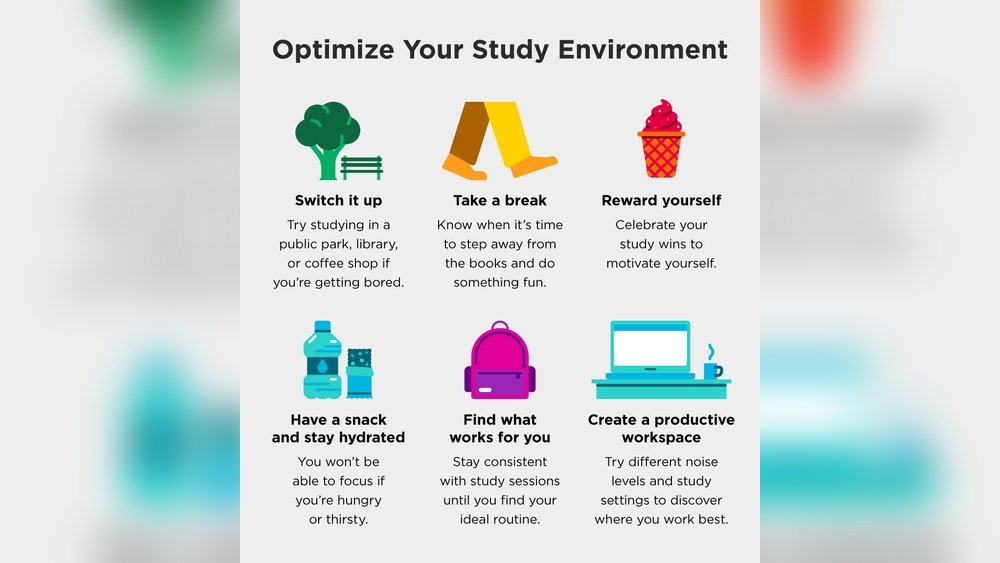
Reward yourself after completing sessions or reaching goals. Even a short break, snack, or a fun activity can help you stay motivated.
Insight: Recognizing progress, no matter how small, keeps your motivation high and builds momentum.
Common Study Mistakes (and How To Avoid Them)
Many students waste hours on methods that do not work. Here’s how to spot and fix them. Avoiding these mistakes can save you a lot of frustration.
Mistake 1: Passive Reading
Just reading or highlighting does not build strong memories.
Solution: Use active recall and self-testing. After reading a section, close your book and summarize what you learned.
Mistake 2: Last-minute Cramming
Your brain cannot process or store everything in one night.
Solution: Use spaced repetition and plan ahead. Even 10–15 minutes of review per day is better than one long session before the test.
Mistake 3: Multitasking
Switching between tasks (like checking your phone) hurts focus.
Solution: Study in focused, timed blocks. Put your phone in another room or use “do not disturb” mode.
Mistake 4: Ignoring Difficult Topics
It’s easy to skip hard subjects, but they need the most practice.
Solution: Start with hard topics when your brain is fresh. Spend a little extra time on them, and ask for help if you’re stuck.
Mistake 5: Not Reviewing
If you don’t review, you forget most of what you learned in a week.
Solution: Schedule regular reviews. Make it a habit to go over old material weekly.
Pro tip: Focusing on “how” you study is as important as “what” you study. A poor method wastes good effort.
Do’s And Don’ts For Effective Study
Here’s a quick side-by-side guide.
| Do | Don’t |
|---|---|
| Use active recall | Just reread notes |
| Mix subjects with interleaving | Study one subject for hours |
| Take scheduled breaks | Study without rest |
| Set clear goals | Start without a plan |
| Review regularly | Cram at the last minute |
Credit: northpennnow.com
Myths Vs. Facts About Study Skills
Some beliefs hold students back. Let’s clear up the most common ones.
| Myth | Fact |
|---|---|
| “Highlighting is enough to remember.” | Active recall and testing are needed for strong memory. |
| “Cramming works if you study hard.” | Spaced learning always beats cramming for long-term memory. |
| “Smart students don’t need to review.” | Even experts forget if they don’t review information. |
| “Multitasking helps you get more done.” | Switching tasks lowers focus and learning quality. |
| “You’re born with a good (or bad) memory.” | Memory improves with practice and better techniques. |
How To Stay Motivated
Motivation can fade, especially during long terms or tough topics. Here’s how to keep going. Remember, discipline often beats motivation, but you can build both.
1. Find Your “why”
Connect your learning to real goals—better job, new skills, travel, or helping others. Write your reasons where you can see them.
2. Use Accountability
Study with friends, join online groups, or share your progress. Even telling someone your plans increases your chances of following through.
3. Track Progress Visually
Use checklists, charts, or apps to see your wins. Seeing improvement—even small—keeps you going.
4. Mix Up Subjects
Switch between topics to keep things fresh and avoid boredom. Even changing location or method can boost energy.
5. Reward Yourself
Treat yourself after big milestones—like a movie night or a favorite meal. Make rewards healthy and motivating.
Key takeaway: Motivation is built by progress. Small wins lead to big results.
Applying Study Skills In Real Life
Study skills are not just for school—they help in every part of life. When you know how to learn, you can adapt to new challenges and changes faster.
- Career: Learn new tools or systems faster, prepare for interviews, or lead effective meetings.
- Languages: Memorize words and grammar efficiently, practice speaking, and build confidence.
- Certifications: Pass exams with less stress by organizing materials and practicing under test conditions.
- Personal growth: Reading, hobbies, or new skills like cooking, programming, or playing music.
Example: A project manager uses mind maps to plan projects and SRS to remember key terms. A language learner uses spaced repetition for vocabulary and the Feynman technique to practice speaking.
You’ll also find that the confidence you build from learning well transfers into other areas of your life—decision-making, communication, and problem-solving.
Best Tools And Resources (2026 Edition)
There’s no shortage of apps, books, and websites. Here are top picks:
- Anki (SRS flashcards for any subject)
- Quizlet (practice tests, games, flashcards)
- Forest (focus timer that grows a virtual tree)
- Notion (for organizing notes and goals)
- Google Calendar (for scheduling study sessions)
If you want to go deeper, explore books like “Make It Stick” or “A Mind for Numbers.” For more in-depth research, check out Wikipedia: Study Skills.
Credit: www.naspa.org
Key Takeaways
- study Skills Are Learnable And Improve With Practice.
- active, Spaced, And Varied Methods Work Best.
- avoid Passive, Last-minute Cramming And Multitasking.
- motivation Grows With Small Wins And Clear Goals.
- choose Tools And Methods That Fit Your Style And Needs.
Frequently Asked Questions
How Many Hours Should I Study Each Day?
It depends on your goals and schedule. Most experts suggest 1–3 focused hours a day for deep learning, with breaks included. Quality matters more than quantity. If you’re just starting, even 30–60 minutes a day can make a difference.
What Is The Single Most Effective Study Technique?
Active recall (testing yourself without looking at notes) is supported by the most research. Combine it with spaced repetition for best results. Self-testing helps you find gaps early and fix them.
How Do I Avoid Distractions While Studying?
Create a dedicated space, turn off notifications, and use focus apps. Let family or roommates know your study schedule. If you can, remove digital distractions or study in a library.
Is It Better To Study Alone Or In Groups?
Both have benefits. Study alone for focus, but use groups for discussion and teaching. Try to balance both. If you struggle with motivation, a study partner can help you stay on track.
How Can I Remember What I Study For A Long Time?
Use spaced repetition, review regularly, and teach what you learn. Link new facts to things you already know. Make your own quizzes and revisit them weekly.
Learning how to learn is a skill that pays off for life. Start small, keep improving, and you’ll see results—no matter the subject or exam.