
Did you know that students who *actively explain* concepts to others can remember up to 50% more information than those who just read or review notes? This powerful effect is at the heart of the Feynman Technique, a simple but effective method to master any subject. Named after Nobel Prize-winning physicist Richard Feynman, this approach can help anyone—from high school students to working professionals—study smarter, not harder. If you want to learn deeply, avoid rote memorization, and actually *understand* what you study, the Feynman Technique is a tool you need.
People often think that studying means reading textbooks for hours or repeating the same notes again and again. But these methods often lead to shallow learning. You might recognize a definition, but struggle to apply it or explain it to someone else.
The Feynman Technique flips this pattern. By making you explain ideas in your own words, it forces your brain to connect facts and concepts. This method turns passive reading into active learning—something most learners never do, but top students and experts use often.
What Is The Feynman Technique?
The Feynman Technique is a four-step method to learn and remember information by explaining it in simple language. Feynman believed that true understanding means being able to break down a concept so a child could grasp it. He was famous for asking, “If you can’t explain it simply, you don’t really understand it.” This method is not about memorizing long definitions or using fancy words. Instead, it helps you get to the heart of any subject.
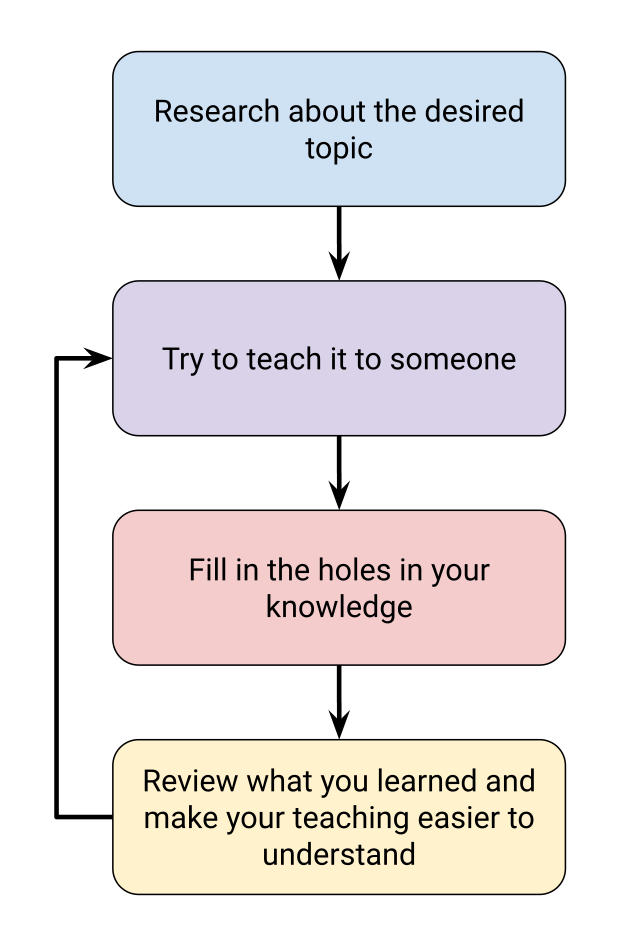
At its core, the process involves:
- Choose a topic
- Explain it in simple terms
- Identify gaps and review
- Simplify and use analogies
You do not need expensive tools or advanced skills. Just a notebook, a pen, and curiosity. Many students use blank sheets, index cards, or even digital note apps—what matters is the process, not the tools.
| Step | Action | Goal |
|---|---|---|
| 1 | Pick a concept | Focus your learning |
| 2 | Explain simply | Check your understanding |
| 3 | Find gaps & review | Fill missing knowledge |
| 4 | Refine & use analogies | Simplify for long-term memory |
Some learners add a fifth step: repeat the process for weak spots until you can explain everything smoothly. This extra loop helps you truly master difficult material.
Why Does The Feynman Technique Work?
Learning is not just about reading or listening—it’s about processing and recalling. The Feynman Technique pushes you to actively interact with information, which strengthens brain connections. When you explain, your brain must find ways to organize details and decide what is important. This makes it easier to remember and use ideas later.
This method:
- Forces you to organize thoughts
- Makes you see what you don’t know
- Encourages you to use your own words
Research shows that teaching others can double retention rates compared to passive review. When you explain, you reveal gaps in your understanding and fix them quickly. This is why many top students form study groups or teach friends—they learn better by explaining.
Another reason this method works: it makes you move information from short-term to long-term memory. Passive review, like reading notes, often stays in your short-term memory and fades quickly. Actively explaining helps make stronger, lasting memories.
Key Benefits
- Improves long-term memory
Because you connect ideas and repeat them in your own words, you remember more for longer periods.
- Prevents rote memorization
You focus on understanding, not just copying information.
- Builds confidence
When you can explain something simply, you feel sure about your knowledge.
- Works for any subject
Science, math, history, languages—the Feynman Technique is flexible.
- Saves time in the long run
Instead of re-reading over and over, you fix weak spots early, so you don’t have to cram before exams.
How To Use The Feynman Technique: Step-by-step
Let’s break down each step so you can start using the Feynman Technique right now. Each step is practical and you can follow it for any topic, from biology to business. It works whether you are preparing for a test, learning for work, or just curious about something new.
1. Choose A Concept To Study
Pick a topic you want to understand. It can be as broad as “Photosynthesis” or as specific as “How compound interest works. ”
Pro tip: Write the topic at the top of a blank page. This focuses your mind and gives a starting point.
Example:
Let’s say you’re learning about gravity in physics. At the top of your page, write: “How gravity works.”
Choosing a specific concept helps you avoid feeling overwhelmed. If a topic is too big (like “History of World War II”), break it into smaller parts (“Causes of World War II,” “Major Battles,” etc. ).
2. Explain The Topic In Simple Language
Imagine you are teaching a 12-year-old. Write out everything you know about the topic without using jargon or complex words. If you get stuck, mark the spot.
Example:
Instead of: “Photosynthesis is the process by which plants convert light energy into chemical energy.”
Write: “Plants use sunlight to make food from air and water.”
If you find yourself using words you can’t explain, pause and try to define them. This is a sign you need to learn more about that part.
Extra tip: Draw simple diagrams or use colored pens. Visuals can make your explanation clearer.
3. Identify Gaps In Your Explanation
Go back to textbooks, videos, or trusted sources to fill in the blanks. Focus on the areas where you hesitated or couldn’t explain clearly.
Common mistake: People skip this step and assume they already know. Always check your understanding.
You might realize you can explain what gravity is, but not how it affects the tides. Or you might be able to describe a math formula, but not why it works. These are the gaps you need to fill.
Helpful approach: Ask yourself, “Where would a beginner get confused?” and “What questions would they ask?” If you can’t answer, look it up.
4. Simplify Further And Use Analogies
Read your explanation again. Try to make it even simpler. Use analogies from everyday life.
Example:
“Photosynthesis is like a kitchen where plants cook food using sunlight as the stove. ”
Analogies are powerful because they link new ideas to things you already know. If you can relate a difficult concept to something common, you’ll remember it better and can explain it to anyone.
Pro tip: If you can teach a friend or record yourself explaining, you’ll remember even better. Listening to yourself can reveal unclear spots you missed.
Real-life Example: Learning Algebra With Feynman Technique
Let’s say you want to understand algebraic equations.
- Choose a concept: “Solving for x in equations.”
- Explain simply: “An equation is like a balance. Both sides must be equal. If you add or take away something on one side, do the same on the other.”
- Identify gaps: You realize you’re not sure why you divide by 2 to solve “2x = 8”. You review and see it’s to keep the sides equal.
- Simplify: “If 2 apples equal 8, one apple is 4. To find one, split the 8 into 2 parts.”
Another example: In biology, instead of saying “Mitosis is a type of cell division,” you could explain, “Mitosis is when one cell splits into two cells that are exactly the same, like making a copy of a photo.”
With practice, you’ll get faster at finding and fixing gaps, and your explanations will become clearer.
Credit: www.todoist.com
Tips And Tricks For The Feynman Technique
- Don’t just read—write and speak. Writing makes ideas clear. Speaking out loud helps you catch mistakes you might miss when reading.
- Record yourself. Listening back reveals weak areas. Sometimes, you’ll notice you skip steps or use confusing words.
- Teach a friend or imaginary student. This forces you to clarify. If your friend understands, you’re doing it right.
- Use color or drawings. Visuals help memory. Draw arrows, shapes, or simple pictures to explain steps.
- Review regularly. Spaced repetition cements knowledge. Go back to your explanations after a few days and see if you can still explain them.
Non-obvious tip: Try explaining the topic in different ways. For example, use a story, a diagram, and a list. This variety strengthens your understanding.
Common Mistakes And How To Avoid Them
- Explaining with jargon: If you use words you can’t define simply, you don’t understand them.
- Rushing through steps: Take time with each phase. Deep learning happens when you slow down and think.
- Relying on notes: Try to explain without looking first, then check.
- Not reviewing gaps: Always research confusing parts. Even small gaps can become big problems later.
- Skipping analogies: Analogies make complex ideas stick. Don’t be afraid to get creative.
A common beginner error is thinking, “I’ll just read it one more time and I’ll remember. ” But unless you can explain the concept out loud or in writing, you probably don’t fully know it.
Do’s And Don’ts When Using The Feynman Technique
Here’s a handy summary table:
| Do | Don’t |
|---|---|
| Use your own words | Copy textbook sentences |
| Identify & fix gaps | Ignore what you don’t know |
| Test by teaching others | Study silently only |
| Use simple examples | Stick to abstract ideas |
When Should You Use The Feynman Technique?
- Studying for exams
- Preparing for presentations
- Learning new work skills
- Reviewing complex topics
- Trying to remember details long-term
It works for science, math, history, languages, and even art.
Try using it when you finish a chapter, or when you feel confused after a class. Many people use it weekly as a check-up for their understanding. Even professionals use this technique to prepare talks or write reports.
Myths Vs Facts About The Feynman Technique
Some people misunderstand this method. Let’s clarify:
| Myth | Fact |
|---|---|
| It’s only for science | Works for any subject |
| You need a partner | You can teach yourself or write |
| Takes too much time | Saves time by fixing weak spots early |
| Only for smart people | Anyone can use it |
Some also think it’s too simple to work, but simplicity is the power. Even expert teachers and scientists use it to check their own knowledge.
Practical Applications: Where Can You Use It?
- Medical students: Explaining diseases in simple terms
For example, describing diabetes as “a problem where the body can’t use sugar right. ”
- Language learners: Teaching new grammar to a beginner
For instance, explaining verb tenses with stories from daily life.
- Engineers: Breaking down complex systems for non-experts
“A circuit is like a water pipe, and electricity flows like water. ”
- Business professionals: Explaining financial terms to clients
“Compound interest is like earning interest on your interest, not just your first deposit. ”
- Software developers: Describing code logic to a team
“This function is like a recipe: you put in ingredients, follow steps, and get a result.”
No matter your field, using this technique can make you a better learner and communicator.
Hidden benefit: Employers and teachers notice when you can explain things simply. It shows you truly understand and can help others learn too.

Credit: briggategroup.com
Key Takeaways
- the Feynman Technique Helps You Learn Deeply By Teaching Simply.
- it Works For Any Subject And Any Age.
- Explaining out loud or in writing reveals what you really know.
- focus On Understanding, Not Memorizing.
- use Analogies And Fix Gaps For Best Results.
Frequently Asked Questions
What If I Don’t Have Anyone To Teach?
You don’t need a partner. Write your explanation down or pretend to teach an imaginary student. Even teaching out loud to yourself works.
How Often Should I Use The Feynman Technique?
Use it whenever you learn something new or review old topics. Many students find doing it weekly or before exams most helpful.
Can I Use The Feynman Technique For Advanced Topics?
Yes! The more complex the topic, the more useful it is. Just keep breaking ideas into smaller parts and explain each one simply.
Is This Better Than Flashcards?
Flashcards help you remember facts, but the Feynman Technique helps you understand *why* and *how*. Using both together is even better.
Where Can I Learn More About Richard Feynman And His Teaching Methods?
You can read more about Feynman’s life and methods on the Wikipedia page about Richard Feynman.
The Feynman Technique isn’t just a study hack—it’s a lifelong skill for learning anything, anytime. If you start using it today, you’ll see your confidence and results grow with every topic you tackle.
Credit: www.innovationtraining.org